
Written by 9th graders Aven Westbrook, Kasia Sluka, Sawyer Brown, and Charlie Bordeauxl
___
Over the past few weeks, Woodstock Union High School freshmen have been researching and learning about food insecurity in Vermont. Along the way, we have been given many opportunities to listen to guest speakers, partake in discussions, do hands-on activities, and go on field trips. This unit was designed to inform and help us act upon the problem of food insecurity, not only in our close community, but in the whole state of Vermont.
Starting in Modern World History class, we learned about root causes of food insecurity globally. After a few classes, we started to dive deeper into the cost of living in Vermont and how that may affect food security. First, teachers wanted to bring awareness to the subject on a global scale. In the class called ‘Modern World History’, we followed a walk around activity with posters full of data from 10 different countries. We were asked to record the total food cost and how many people were in each family. This helped us get a larger scale idea of everything before zooming in to Vermont. In our Wellness class, we started our discussion by investigating daily nutrition needs, which led to the effects of poor nutrition. From here, we discussed solutions.
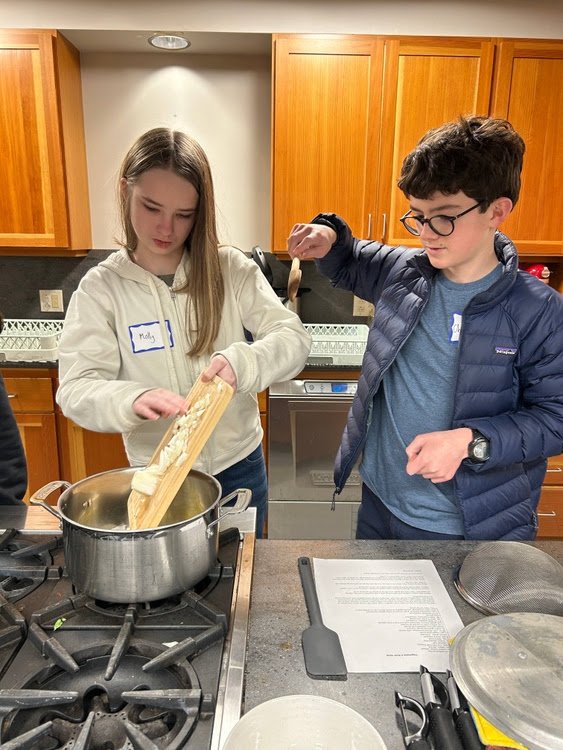
Molly Fielder ‘29 and Charlie Davis ‘29 work together to prepare soup
Two representatives from Hunger Free Vermont joined us to present about programs like SNAP and more local branches of it, like Hunger Free Vermont and 3 Squares VT. This presentation provided statistics about the amount of hunger being faced in our small state. They were open to clarifying questions as well as deeper discussion questions, which gave my peers and us a new understanding of this growing problem.
The next step of this unit was action. Our goal was to help support people who are food insecure in their community. In our Wellness class, we learned about the different food groups and how people don’t always have access to them, which is also a way of being food insecure. Afterwards, we were prompted to create a shopping list with a required number of items in each food group and a budget of $75 (the same amount as weekly SNAP benefits for a qualifying family of 2). We made and printed out lists and were ready for the next step. To help us better understand the topic, our teachers organized field trips so students could directly help the situation instead of watching from afar.
One portion of our field work took place at the Upper Valley CO-OP food store, where we were buying food and checking prices, how nutritious it was and if it was enough for the amount of people we were shopping for. All the groups did lots of math in this process and most groups stayed on budget; if you were over $75 you would work as a team to figure out what to put back. After buying our food, we got back on the bus and drove to the Upper Valley Haven where we donated a total of 247 pounds of food and got a tour of the operations and food market.
Meanwhile, at the Billings Farm and Museum, we learned about the history of farming and agriculture businesses, before competing in a light-hearted, 3 team quiz about making food like butter. Most pom-poms to win! We then broke off into cooking groups. In these groups we made butter, applesauce, and soup. We donated our hand-churned butter and carefully crafted applesauce to the Woodstock Community Food Shelf and our soup to the local Meals on Wheels program through the Thomson Senior Center.
Food insecurity is a huge problem in the United States and around the world. It can seem so out of reach to make a real impact, but even a small donation to the Haven or standing up for SNAP benefits can go a long way. This project made learning about a serious topic fun and engaging while still focusing on the big picture. We think it’s cool that every 9th grader gets to do this project. The 9th grade class was so glad that they could have such a positive impact on food insecurity and hopes that others feel inspired to engage in the topic and help people live longer, healthier lives.