
Psychology class visits Dartmouth EEG Study Lab
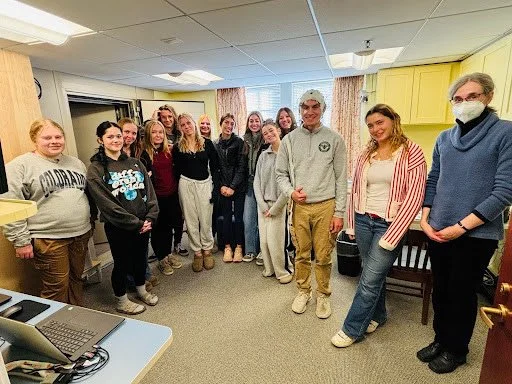
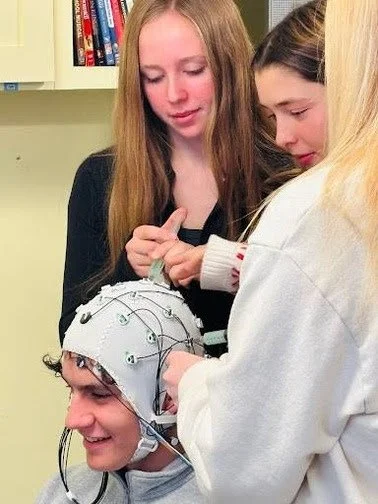
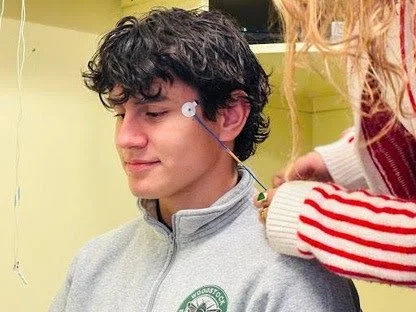
The Psychology Class went on a morning field trip to the Brain Waves Recording Lab at Dartmouth College last Wednesday to visit with Professor Donna Coch and her undergraduate research assistant, Nicole. Students worked with EEG technology as part of our study of the biological bases for behavior. Electroencephalography (EEG) and Electrooculography (EOG) measure the electrical field around the brain and turn it into waves on a screen. EEG doesn’t read minds, but can tell us how active or inactive the brain is while doing certain tasks, or sleeping.
How can this be useful for psychological research? Students suggested:
Comparing introverts to extroverts as they respond to stressful situations
I would experiment with music and see how participants would react to well known and established songs, versus lesser known new releases from more obscure artists…I’m also curious about responses to different genres, and how brain waves would be different depending on if the given genre was rock or classical, or pop or jazz.
Will there ever be a use for an EEG to detect things like dyslexia in an individual?
Take a child who has a hard time focusing vs a child who can pay attention and look at their brain waves to see exactly when the child loses focus: place different stimuli in front of both and see when the child loses focus.
A few student takeaways:
“Psychology includes lots of scientific aspects.”
“The process for EEG scans is still being refined”
“Brain waves during REM sleep is identical to brain waves when you’re awake…Alpha waves happen when you are more relaxed.”
“It was really difficult for Ethan to develop any alpha waves due to his focus.”
“Psychology can be a lot more interactive than I initially realized."