
School news
Planting the future: A freshman's intro to CRAFT
By Isla Segal ‘29
This op-ed first appeared in the October 2, 2025 edition of The Vermont Standard

This past week, I was one of the dozens of kids from Woodstock Union High School that took a field trip to the King Farm to plant chestnut trees and make applesauce. CRAFT, which stands for Community and Climate Resilience Through Agriculture, Forestry, and Technology, is a program at the high school that focuses on nature and sustainability. Students can take classes, such as Economics and the Environment or Regenerative Agriculture, to get CRAFT credits. Once they earn 6 credits in this pathway, they graduate with a CRAFT certification on their transcript. Outside of the certification, the program offers opportunities such as the trip to King Farm, where we as students can work with nature and be out in the world, making a difference.
When we got to school on Tuesday morning, about thirty students gathered in the lobby and went up to the nearby King Farm. This is a property the Vermont Land Trust owns, and our school is partnering with them to do projects such as this one on the land. We stacked firewood and sliced apples that a class had picked at Billings Farm earlier that week, then started boiling them down to make applesauce.
An hour in, many more students came after attending their first class on campus. We talked about the history of chestnut trees and passed around seedlings and pieces of chestnut wood. We planted chestnuts because it’s a tree that has many uses, from wood for furniture to food to eat, and there used to be chestnuts in Vermont and throughout the east coast. They were wiped out about a hundred years ago by a blight. We hope that we can help bring chestnuts back by planting these trees, so we partnered with the American Chestnut Foundation. The small trees we planted grew from seeds harvested from a rare, wild, mature American Chestnut tree in Vermont. The seeds were propagated at our school in air pruning beds. Air pruning beds are raised garden beds with a mesh netting above the ground so that when roots grow through the netting, they dry out and die, causing a more dense root system. What we planted were baby trees, about a foot tall, with several leaves, and a root system about a foot deep. We dug holes into the ground, placed the plants in, and added a soil mix that had pine duff, which helps chestnut trees grow. We put tubes around the top of the tree to help protect it from deer browse and tied those tubes to a stake in the ground. Finally, we watered them and covered the surrounding ground with cardboard to limit weeds. I got to plant two chestnut trees, one in the field, and another in the woods above it, because we tried to plant in both open and forested environments to compare the resiliency of the trees. It was cool to plant multiple trees, because the first time, I was figuring out the process, but by the second time, my partner and I had techniques and we knew what to do. Overall that day, we planted about fifteen trees, and we’ll plant more next year as a part of a several-year-long project.
I find it awesome to have the King Farm property near our school, and I feel so lucky to be able to use it. Currently, some of the older CRAFT students are in a pilot class with the goal of working in collaboration with Vermont Land Trust to design a plan for the property that will incorporate sustainable growing and harvesting practices and make it more open to the community. I look forward to watching these plans unfold and become reality through my years at Woodstock and beyond when I come back to visit.
The morning was my first experience with CRAFT, as I’m a freshman, and it felt like a comfortable community, and the kind of people I want to be around. We had everyone from ninth graders to seniors, and they were all joking around as we sliced apples, or talking to me as we walked up the hill. There were so many different people there, with varied interests, who take different classes, or sit with different people at lunch, but we had all come that morning to be outside, and make applesauce, and get our hands covered in soil, and that brought us all together. I’m glad as I go into high school to have even more role models and friends from other grades, who I can look up to, or who I’ll know when I walk into a new class.
Yoh Theatre performing “Elektra”, October 3-5
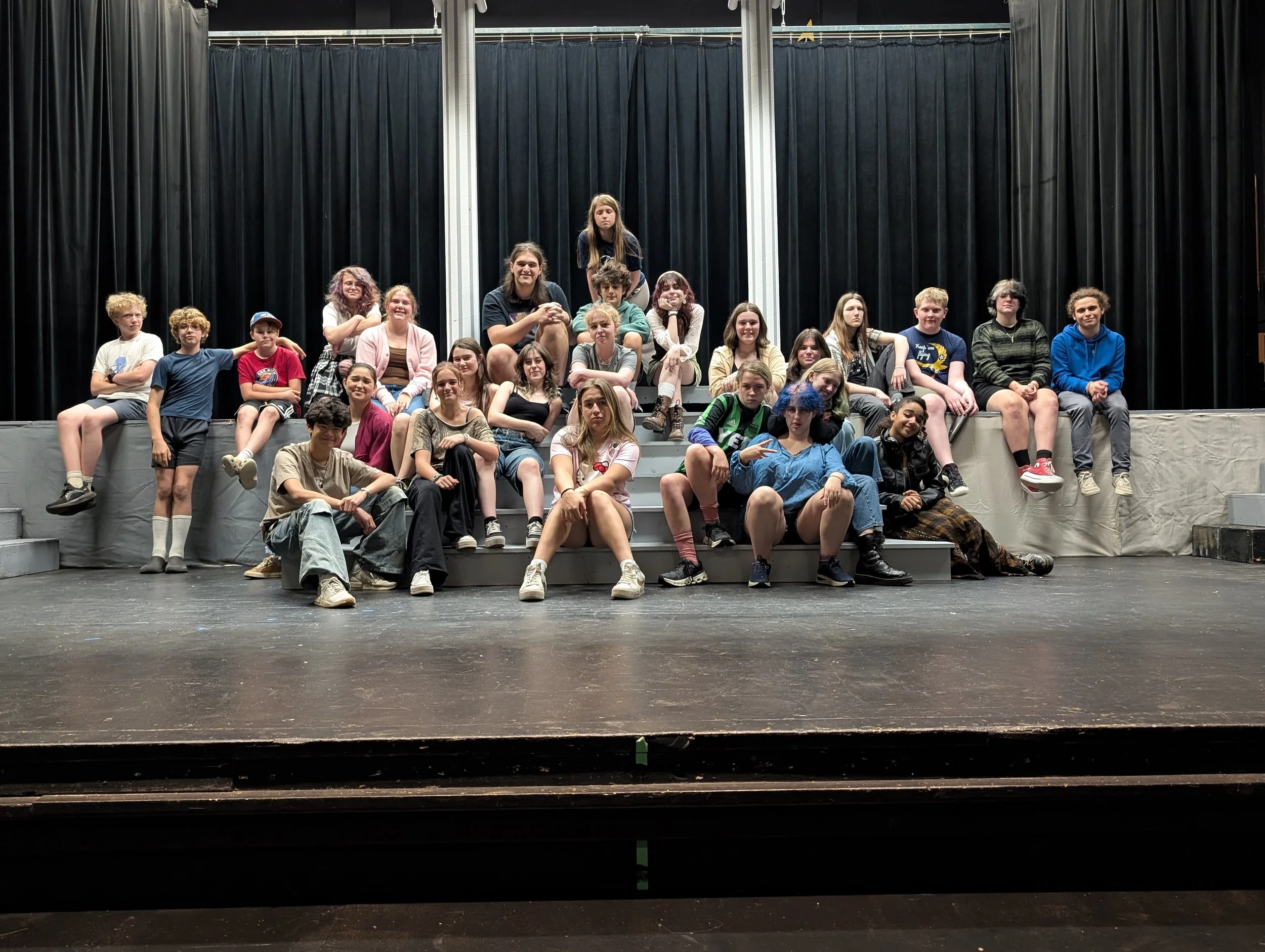
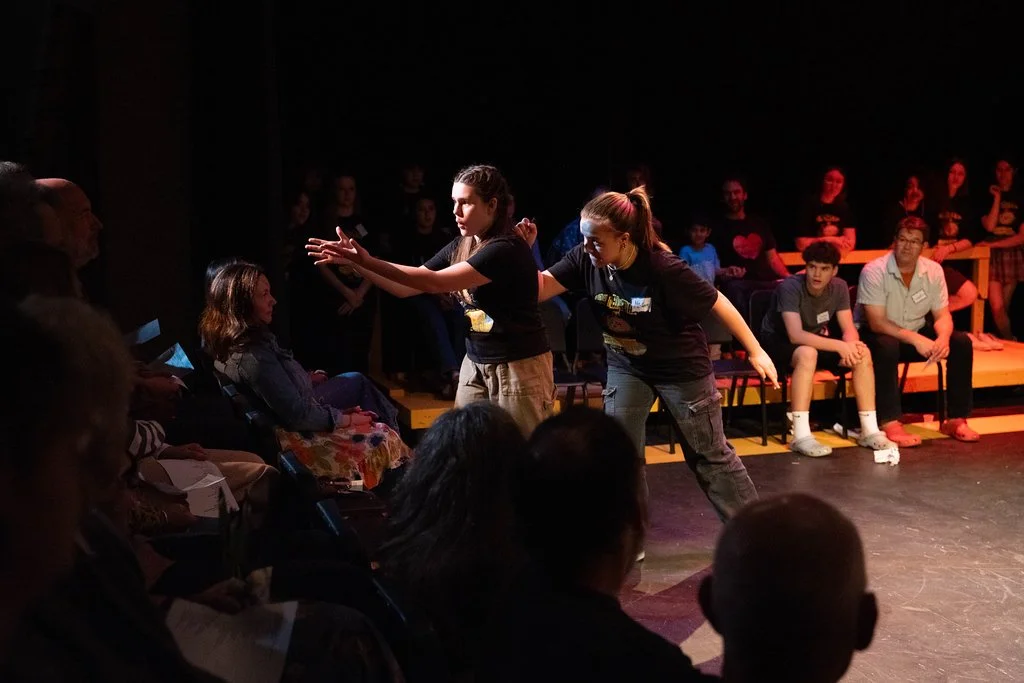
You are invited to Yoh Theatre's performance of Elektra, by Sophokles, translated by Anne Carson, on October 3, 4, and 5. The production features 31 Yoh Players from grades 7-12.
This Greek tragedy speaks the following through the Greek chorus: "Do not breed violence out of violence." "Evil is a pressure that shapes us to itself." "Justice is coming." "Conviction is strong in me."
"I always love the opportunity to write music," says Marcia Bender, Yoh Theatre Director. For this play, she wrote three-part harmonies for the Stasimon, interludes between Episodes, for a six person core of the chorus (Lia Gugliotta, Tee Miller, Ella Hardy, Jay Allen, Grace Foley and Orly Agin), with dissonant harmonies that reflect the mood of the interludes. The full cast list is available on the Yoh Theatre website.
"In spite of the quotes I chose above, this is Greek Tragedy and does not end well!" notes Bender. "But our learning through this ancient storytelling propels us forward, strengthening our resolve to stand firm in our convictions, without violence."
WUHS students gain valuable experience with the VYCC
WUHS students Des Early and Lyon Maksimovic successfully completed a four week Vermont Youth Conservation Corps crew experience. They worked at Marsh-Billings-Rockefeller National Historical Park on a variety of projects from lumber management to kiosk installation to creating new water drainage on their network of hiking trails.
Des and Lyon learned valuable leadership skills when they worked with The Community Campus campers to maintain trails, and walked away with a long list of new technical skills.
Des is earning school credit for this experience through Woodstock Union’s Center of Community Connections (C3).
Well done, Des and Lyon!


AP Art History starts year in a prehistoric cave

Dr. Gravel’s AP Art History students didn’t just learn about prehistoric art on their first day of class—they lived it. To kick off Unit 1, Dr. Gravel transformed her classroom into a prehistoric cave. The room was dimly lit with lanterns and candles, and students used charcoal to sketch animals and human figures on simulated “cave walls.”
The immersive activity wasn’t just for fun—it illustrated the way early artwork reveals what mattered most to cultures without a written language. Students discussed why animals were depicted with intricate detail while people were drawn as simple stick figures: animals were vital to survival, as they provided food in a world where the next meal was never guaranteed.
Using charcoal connected students to history in another way—it’s an organic material that archaeologists and historians rely on for radiocarbon dating, stratigraphic dating, and contextual evidence to understand when and why buried art was made.
Students left with a deeper appreciation for the idea that art is more than images on a wall—it is a record of survival, culture, and human experience. As one student shared, “It felt like we were really in a cave making history.” Another commented, “How cool it was… this is where it all started.”

By stepping into the past, students began to see how art tells the story of humanity when words are not available.
Using charcoal connected students to history in another way—it’s an organic material that archaeologists and historians rely on for radiocarbon dating, stratigraphic dating, and contextual evidence to understand when and why buried art was made.
Students left with a deeper appreciation for the idea that art is more than images on a wall—it is a record of survival, culture, and human experience. As one student shared, “It felt like we were really in a cave making history.” Another commented, “How cool it was… this is where it all started.”
By stepping into the past, students began to see how art tells the story of humanity when words are not available.

Woodstock Union HS Poetry Out Loud Contest 2025

Woodstock tucked in its 2025 Poetry Out Loud Competition on February 12th, ahead of winter vacation, and just ahead of the second of three big snow storms. Twenty two students participated in the recitation competition, held in The Rhoda Teagle Library, and attended by peers in 9th through 12th grades.
Pictured above: Owen Courcey as Accuracy Judge
Poetry Out Loud is a national competition that has its inception in high school classrooms across the country, and grows from there to schoolwide- competitions, state regional competitions, a state final competition and ultimately to a national competition in Washington, D.C.
Pictured above: Josh Byrne recites "The Conqueror Worm" by Edgar Allen Poe

Recitation is a particular art. Poetry Out Loud has rigorous judging guidelines, encompassing a student’s physical presence, voice and articulation, interpretation, evidence of understanding, and overall performance. Far more than memorization, in so many words recitation requires the competitor to be the “vessel” for the poem’s performance.
Pictured above: Liam Wheeler recites "The Kiss" by Robert Graves

Recitation asks the student to deliver the poem in a way that clarifies the poem’s meaning, makes its words, imagery, figurative language, rhythm and meter, even punctuation, the star, over the person delivering the art. It’s a nuanced experience, demanding exactitude as well as effective interpretation.
Pictured above: Tula Klock recites "What to Say Upon Being Asked to Be Friends" by Julian Brolaski

The range of ideas and wisdoms across the twenty two poems students selected from The Poetry Out Loud Anthology was remarkable, cautionary, and encouraging, depending. And yet, “at bottom,” all boils down to “Words” (Haaken Oates’ choice by Pauli Murray) -- words’ selection, combination and arrangement. To offer a small sample: there were pleas for unity and community in poems like Santino Bohren’s recitation of “About Standing (in Kinship),” and Vasco Malik’s delivery of “We all receive the invitation”; Sam Hauze’s prose poem selection, “Don’t Bother the Earth Spirit” and Agnes Kardashian’s interpretation of “Walking with My Delaware Grandfather,” along with Jake Blackborn’s rendition of “Wind, Water, Stone,” offered nostalgic respect for ancestral and/or earthly wisdom, revealing the power of reflection to offer a kind of present eternity.
Pictured above: Tegan Miller recites "Summer" by Chen Chen

A number of student selections grappled with war and heroism/anti-heroism, from long ago, as was the case with Luke Pomeroy’s interpretation of Rupert Brook’s “The Soldier,” and Ayron Romanczak’s rendition of Henley’s famous “Invictus,” to the present, as reflected by poems such as Zara Khan’s selection “From the Sky,” or Mimi Kanda-Olmstead’s recitation of “To the Oppressors”. As Kirkegard once said, “Where tragedy occurs, the comic is present.” Such was the case with Josh Byrne’s rendition of “The Conqueror Worm”. In the end, poems having to do with some kind of love and humanity seemed to take the top slots: Quinn Eckler’s recitation of “The Universe as Primal Scream” (Tracy K. Smith) and Liam Wheeler’s rendition of “The Kiss” (Robert Graves) tied for third place (157 points each), Lylah Zeitlin captured second place (170 points), reciting “Siren Song” (Margaret Atwood) and Tegan Miller emerged as Woodstock’s 2025 POL School Champion with 178 points and her recitation of “Summer” by Chen Chen.
Pictured above: Judges and Scoring Team prepare for the next recitation
Tegan Miller, ‘27, will represent Woodstock at the southern Vermont Regional Poetry Out Loud Contest to be held at The Barre Opera House on Thursday, March 6th. Tegan will recite “Summer” at that competition, along with a second poem, “Friendship After Love” by Ella Wheeler Wilcox.
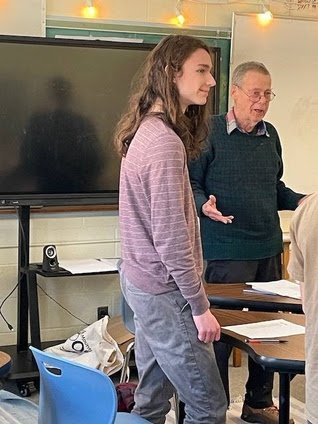
Pictured above: Poetry Out Loud work in the classroom: Guest Teaching Artist Geof Hewitt works with Liam Wheeler on "The Kiss" by Robert Graves

The state final competition will consist of the top 5 recitations from the southern and northern regional competitions, respectively, and will take place at The Flynn in Burlington on Friday, March 14th, where finalists will recite three poems each to vie for the state champion and the opportunity to represent Vermont at the national competition in Washington, D.C. (April, 2025).
Pictured above: Mr. Clifford addresses the competitors and audience

Congratulations to all the students who participated with verve and rigor in Woodstock’s 2025 Poetry Out Loud Contest! Many Thanks to our 2025 judges: Mike Loots, Nathalie Kramer, Janet North, Detlef Hagge, Jessica Oakman, and accuracy judge: Owen Courcey. Ms. SJ as prompter and the dynamic scoring team, Heather Vonada & Andy Smith, along with scoring sheet “runner,” Jack Quicker, were invaluable to delivering a smooth contest, as were Mrs. Murphy and Ms Piccoli in “styling” the library space to accommodate the contest.
Pictured above: A poem is a sweet treat, but so are Ms. Hayslett's homemade heart cookies, Abbie's homemade pumpkin bread and Perk's oatmeal chocolate chip fruit bars
